GSTR-9 for FY 2025-26: The First Annual Return With Two Rate Regimes In It
 SmartLedger AI
Due 31 December 2026, but the real deadline is 30 November. GST 2.0 landed on 22 September 2025, so this year's annual return carries two rate structures. The four-step reconciliation, the blended-line error the portal flags automatically, and what to do before 10 November.
GSTR-9 for FY 2025-26 is due on 31 December 2026, and the portal has been open for it since early October. On the surface it is the same annual return as every year: consolidate twelve months of GSTR-1 and GSTR-3B, reconcile ITC against GSTR-2B, add GSTR-9C above ₹5 crore.
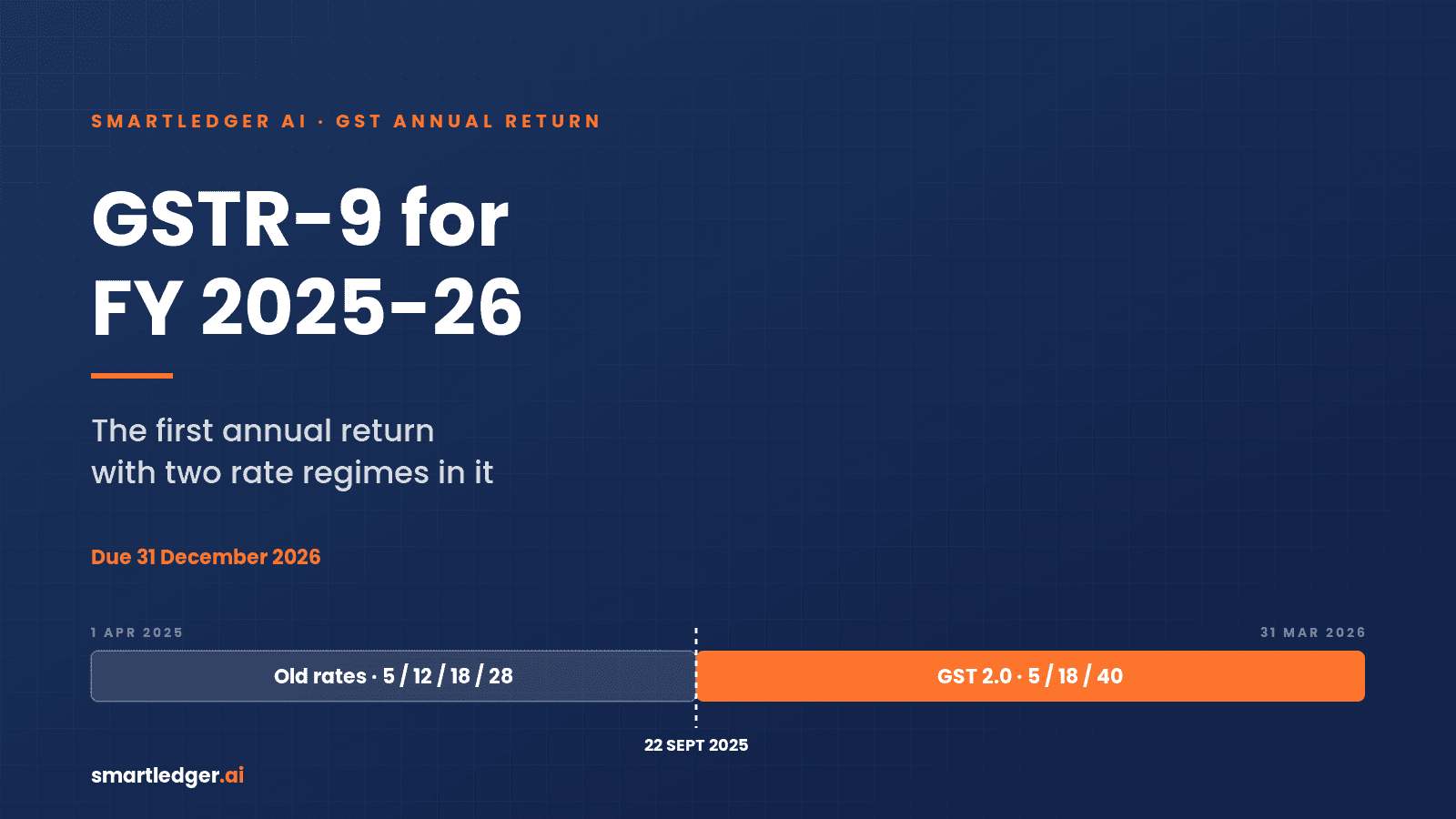
What makes this year different is a date in the middle of it. GST 2.0 took effect on 22 September 2025. For the first time, a single annual return carries two rate structures: the old 5, 12, 18 and 28 percent slabs up to 21 September, and the new 5, 18 and 40 percent structure from the 22nd onward. The same product, sold in August and again in October, legitimately sits on two different rate lines.
Every guide you will find covers thresholds and due dates. This one is about the part that will actually generate notices.
Who files, and what it costs to be late
 The turnover test trips people up every year, so once more: it is aggregate turnover on the PAN, all GSTINs across India. A group with three state registrations totalling ₹6 crore is over the ₹5 crore line for GSTR-9C even if no single registration crosses ₹2 crore.
The late fee is graded now, which makes it feel soft for smaller taxpayers. A ₹3 crore business filing forty days late owes ₹2,000. Above ₹20 crore it is ₹200 a day with a 0.5 percent cap, and missing the annual return also blocks subsequent monthly filings, which is the cost that actually hurts.
The rate-change reconciliation
Work it in this order. Each step feeds the next.
1. Draw the line at the close of 21 September. Every outward supply up to that date carries the old rate, everything from the 22nd carries the new one. Tables 4 and 5 ask for supplies rate-wise, so a product that moved from 12 to 18 percent appears on two lines. Do not blend it into one to make the table look tidy.
 The blended line is the single most common error this year, and it is self-reporting: the GST column will not equal the sum of your twelve GSTR-3Bs, and the portal flags the difference automatically.
2. Split Table 17 the same way. The HSN summary is where the rate change is most visible. For any HSN whose rate moved, pull the summary in two date ranges and report them as separate lines. If your software was updated mid-year and you run one report for the whole year, it will map every unit to whatever rate is current today, and the pre-September quantities will be wrong.
3. Credit notes carry the original rate. Goods sold in August at 12 percent and returned in October are credited at 12 percent, not 18. In the annual return that credit note reduces the old-rate line. Getting this backwards is the second most common error, and it compounds, because the ITC reversal on the other side is also at the wrong rate.
4. Tie Table 6 and Table 8 to GSTR-2B. Table 6 should equal the ITC you claimed across twelve 3Bs. Table 8 reconciles that against 2B. If you have been doing a proper monthly 2B reconciliation under IMS, this table is almost mechanical. If you have not, this is where the year's accumulated gaps surface at once, and the reversals belong in Table 7.
Two deadlines before the deadline
The 31 December date is not the one to worry about. Two earlier dates decide whether the annual return is clean or a confession.
30 November 2026 is the last date to claim any remaining FY 2025-26 ITC and to amend FY 2025-26 invoices in GSTR-1. That is the GSTR-3B and GSTR-1 you file in November for the October period. Anything you discover in the annual return after that cannot be fixed in the monthly returns; it can only be disclosed, and any excess ITC paid back through DRC-03 with interest.
So the practical sequence is: run the annual reconciliation in October and early November, fix what you find in the November filing, and use December only for preparing and filing the return itself. Firms that start the reconciliation in December are not reconciling. They are documenting what they can no longer correct.
30 September 2026 has already passed, and it mattered: under Rule 37A, ITC claimed on invoices from any supplier who had not filed their GSTR-3B by that date has to be reversed. Check the supplier-filing status column in your 2B history before you finalise Table 6.
Running this across a client list
For one business the sequence above is a day or two of work. For a CA firm it is the same sequence across every client above ₹2 crore, each with its own rate-change profile, in the same five weeks that monthly filings and tax audit follow-ups also land.
The time goes to three things: pulling twelve months of 1, 3B and 2B per client, splitting every outward supply and HSN line at 22 September, and matching the ITC tables to the monthly 2B history. None of that is judgment. All of it is data assembly, and it is what GST filings in SmartLedger AI prepares from the books: the rate split falls out of invoice dates, the 2B history is already there from monthly reconciliation, and the draft tables are presented for review rather than filed. The CA's time goes to the exceptions, the credit-note rate check and the sign-off, which is where it should have been all along.
What to do this week
List every client above ₹2 crore on aggregate PAN turnover, not per GSTIN. That is your GSTR-9 population. Flag the ones above ₹5 crore for 9C.
For each, pull the outward supply register in two date ranges, 1 April to 21 September and 22 September to 31 March, and check whether any HSN appears at a different rate in each. Those clients go to the top of the list.
Pull the 2B history and look for suppliers who had not filed by 30 September. Those reversals have to be in the November 3B.
Do those three things before 10 November and the annual return becomes a formality. Leave them to December and the deadline you miss will not be 31 December. It will be the 30 November one you did not know was the real one.
Thresholds, due dates and late-fee slabs as of October 2026, per Notification 15/2025-Central Tax and the GST portal. The GST 2.0 rate structure took effect 22 September 2025. GST rules change frequently; confirm the current position before acting on a specific case.
SmartLedger AI
AI For all you Financial Services
Related Solutions
GST & Filings
File GST returns from SmartLedger and see every due date, error and ITC risk
SmartReconciliation
Bank reconciliation that matches every statement line to your invoices and bills
For Accountants
Reduce repetitive reconciliation and compliance overhead.
Small Business Solutions
Run accounting and GST workflows with lean teams.