GSTR-2B Reconciliation in 2026: Every ITC Mismatch You Will Find, and What to Do Before the 20th
 SmartLedger AI
GSTR-2B Reconciliation in 2026: Every ITC Mismatch You Will Find, and What to Do Before the 20th
Until last year, GSTR-2B reconciliation was a comparison. You pulled the statement on the 14th, matched it against the purchase register, and claimed what appeared in both. The gaps were the supplier's problem.
In 2026 that is no longer how it works. GSTR-2B is now built from what you do in the Invoice Management System. Accept a record and it flows into your ITC. Reject it and it does not. Do nothing and it is deemed accepted. The statement is no longer something that happens to you. It is the output of decisions you made, or failed to make, before the 14th.
That changes who is responsible for a mismatch, and it changes what reconciliation is for.
What actually changed
IMS became mandatory from April 2026 for regular taxpayers filing GSTR-3B. Section 38 of the CGST Act was substituted by Notification 16/2025 to tie ITC to the records a recipient accepts, or is deemed to accept, in IMS.
GSTR-2B is recomputable. If you change an IMS action after the 14th, you must recompute 2B before filing 3B. Pulling the statement once and filing from it is no longer safe.
Credit notes cannot sit pending forever. Since October 2025, qualifying credit notes and amendments can be kept pending for one following tax period only. After that, act or accept the reversal. When you do accept, the "ITC to be reduced" field lets you declare a partial amount if you never claimed the full credit.
GSTR-3B Table 4 is being locked to auto-populated 2B figures in phases through 2026. The room to type a number that differs from the statement is closing.
Rule 88D is automated. Claim more ITC in 3B than 2B supports beyond the threshold and the portal issues a DRC-01C. You get seven days to pay via DRC-03 or explain the difference. There is no human on the other end deciding whether to send it.
Put those together and the shape of the job is clear. Reconciliation used to find the gap after the fact. Now it has to prevent the gap before the 14th, because after the 20th the gap is a notice.
The seven mismatches you will find
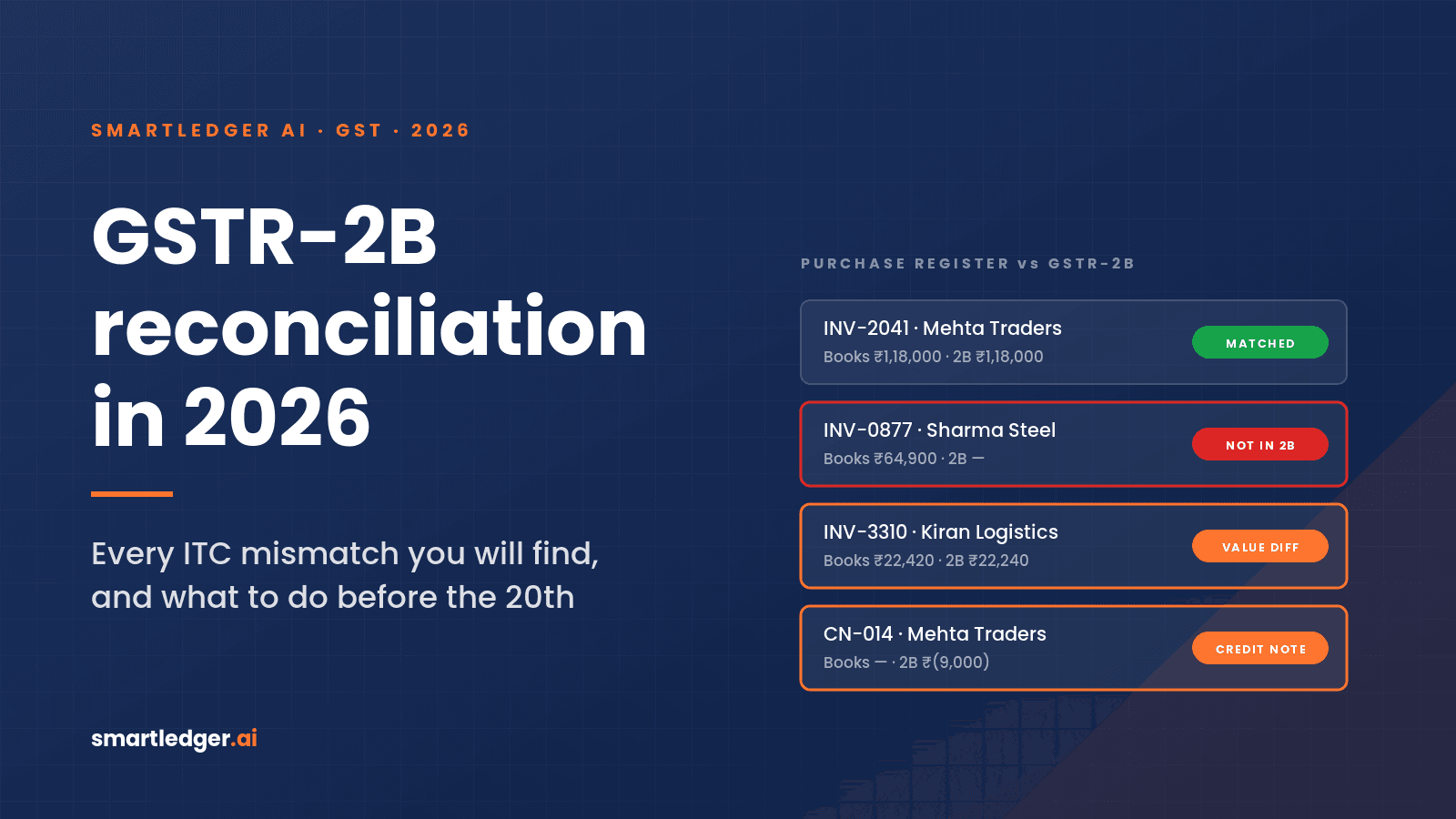
Every 2B reconciliation turns up the same categories. The action for each is different, and getting it wrong in either direction costs money: claim too much and you get a DRC-01C; reject in error after 3B is filed and the ITC is gone for the period.
 Two of these catch firms out more than the rest.
Value differences. The instinct is to claim what the invoice says. The rule is to claim what 2B says. If the supplier reported ₹22,240 and the invoice reads ₹22,420, the ₹180 is not yours until the supplier amends. Topping up from the invoice is exactly what Rule 88D is built to catch.
Rejection timing. Before 2B is generated, a wrong rejection can be flipped back to accept and 2B recomputed. After 3B is filed for that period, the action locks and the record sits in the "ITC Rejected" section. The window for an honest mistake is the 14th to the 20th, and it closes hard.
The monthly sequence
The reconciliation itself is the easy part. The discipline is in the calendar.
 The step most firms skip is the first one. If purchase bills are still being entered on the 12th, IMS actions on the 13th are guesses, and 2B on the 14th reflects the guesses. Everything downstream inherits the error.
Two deadlines sit outside the month and are easy to lose. ITC on any invoice must be claimed by 30 November of the following financial year. And under Rule 37A, if a supplier has not filed their GSTR-3B by 30 September of the next year, the ITC you claimed on their invoices must be reversed, with interest if you leave it past 30 November.
Where this breaks at scale
For one company with 60 supplier invoices a month, the sequence above is an afternoon. For a CA firm running it across 80 clients, it is 80 afternoons compressed into the five days between the 14th and the 20th, with the same partner signing off on all of them.
That is the part no amount of discipline fixes, and it is where the work has to change rather than the effort.
Matching is a rules problem: same GSTIN, same invoice number, same tax amount, within tolerance. It is exactly the kind of work that should be done before a human looks at it, with only the exceptions reaching a reviewer. This is what GST reconciliation in SmartLedger AI does for every client at once. It pulls 2B, matches it against the books, sorts every line into one of the seven buckets above, and presents the exceptions with the suggested IMS action. Nothing is accepted, rejected or filed until someone on the firm reviews the list.
The output is a short exception list per client instead of a long spreadsheet per client. That is the difference between a five-day crunch and a review you can actually do properly.
Three things to do this month
Move the purchase close to the 10th. If that is not possible for a client, that client is your biggest 2B risk, regardless of their size.
Audit your "no action" records. Every record you did not touch in IMS was deemed accepted. Pull last month's list and check whether any of them were wrong-GSTIN or duplicate invoices. That is ITC you have already claimed on someone else's purchase.
Run one client through an automated match and count the exceptions it finds that your team did not. The free plan for CA firms covers unlimited clients with no card and no time limit, so the comparison costs nothing.
GSTR-2B used to be a report you read. In 2026 it is a record of what you decided. Reconcile accordingly.
Rules and dates as of October 2026, drawn from CGST Section 38 as substituted by Notification 16/2025-Central Tax, GSTN advisories on IMS and GSTR-2B recomputation, and Rules 37A and 88D of the CGST Rules. GST rules change frequently; confirm the current position on the GST portal before acting on a specific case.
SmartLedger AI
AI For all you Financial Services
Related Solutions
GST & Filings
File GST returns from SmartLedger and see every due date, error and ITC risk
SmartReconciliation
Bank reconciliation that matches every statement line to your invoices and bills
For Accountants
Reduce repetitive reconciliation and compliance overhead.
Small Business Solutions
Run accounting and GST workflows with lean teams.