57th GST Council Meeting: No New Rates, Everything Else Changed
 SmartLedger AI
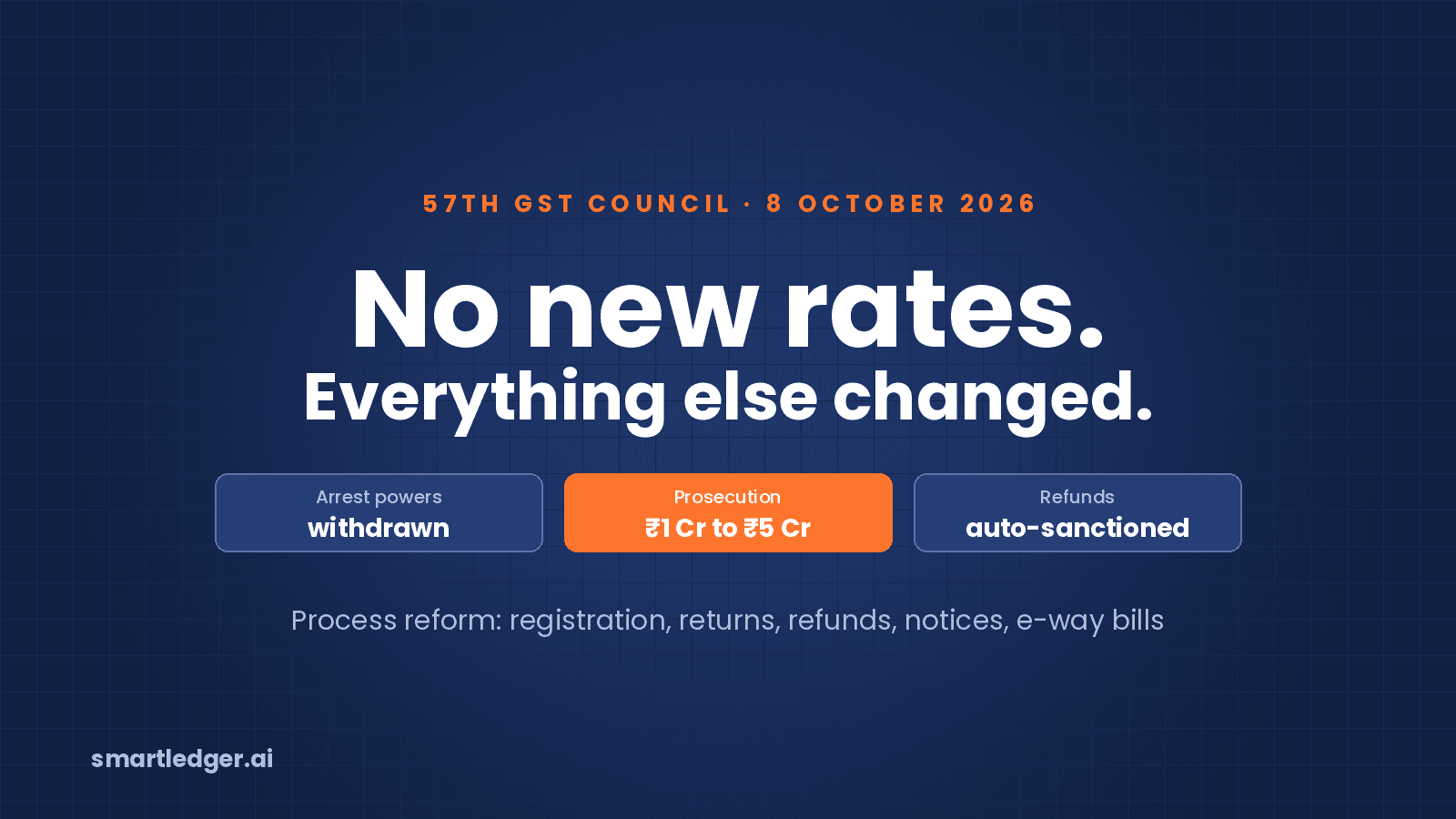
The 8 October 2026 Council left every rate alone and rewrote enforcement, refunds, returns and registration instead: arrest powers withdrawn, prosecution from ₹5 crore, no notices under ₹10,000, auto-sanctioned refunds, ITC refunds on input services from 1 Nov 2026 and capital goods from April 2027. What changes, when, and what to do now.
The 56th GST Council meeting rewrote the rate card. The 57th, held in New Delhi on 8 October 2026, left every rate where it was and rewrote almost everything else: who can be arrested, when a notice can be issued, how a refund is sanctioned, how a truck can be stopped, and how a registration is granted, amended or cancelled. The official release runs to nineteen numbered items. These are the ones that will change how you file, pay and get paid, with the dates that matter.
One caution up front, in the Council's own words: the recommendations "would be given effect through the relevant circulars, notifications and law amendments which alone shall have the force of law." Nothing below applies until it is notified. Two items already carry dates.
 1. Arrest powers go, prosecution starts at ₹5 crore
The headline is the complete withdrawal of the power of arrest under GST by omitting Section 69 of the CGST Act. Alongside it, the monetary threshold for prosecution rises from ₹1 crore to ₹5 crore, the catch-all offences in Section 132(1) ("evades tax", "or in any other manner deals with") are deleted, and the ITC offence in clause (c) is narrowed to fraudulent credit taken without any receipt of goods or services or without an invoice. For the nine years since 2017, the threat of arrest has been the lever in most large GST disputes; from the date of amendment it is a civil matter with a much higher criminal floor.
2. No show-cause notice below ₹10,000
Sections 73, 74 and 74A get a statutory minimum: no demand notice where the tax involved (CGST, SGST, IGST and cess together) is under ₹10,000. The Council went further and recommended that pending notices and appeals below that figure be decided as if the threshold had always existed. For a small business that has spent two years on a ₹6,000 ITC mismatch, that is the end of the matter.
Three related changes soften the rest: the maximum general penalty under Section 125 falls from ₹25,000 to ₹10,000; in non-fraud cases the penalty for paying tax and interest within 30 days of the order (60 under 74A) drops from 10% to 5%, with the ₹10,000 minimum removed; and the pre-deposit for appealing a penalty-only order is capped at ₹40 crore. A circular will set standards for the quality and timing of notices and for personal hearings, which field formations have been uneven on.
 3. Trucks can only be stopped on intelligence, and never in a transit state
Sections 68, 129 and 130 are to be amended so that a conveyance can be intercepted only on specific intelligence, with the authorisation of an officer not below Joint Commissioner, and only in a state where either the supplier or the recipient is located or registered. Goods moving from Gujarat to Tamil Nadu cannot be detained in Maharashtra. Confiscation under Section 130 will not apply to goods in transit at all. The one exception keeps its teeth: a vehicle with no e-way bill, or no document showing origin and destination, can be inspected and detained anywhere. If you move goods, that makes the e-way bill threshold and validity the whole game.
4. Refunds without an officer
Section 54 is to be amended for system-based refunds in two phases. In phase one, excess balance in the electronic cash ledger is refunded automatically in full; acknowledgement or deficiency memo must issue within 10 days (down from 15) or is deemed issued; and for zero-rated and inverted-duty claims, 90% is sanctioned provisionally by the system on a risk score. Phase two automates the acknowledgement and the full sanction for zero-rated claims after adjusting dues. The RFD-01 form becomes machine-readable and the scanned-document upload goes for export and inverted-duty claims. The 1.5-times cap on export turnover in rule 89(4)(C) is removed, and the ₹1,000 minimum refund is clarified to apply to the total across CGST, SGST and IGST.
5. Two refunds that never existed, with dates
Inverted-duty businesses have never been able to get back ITC on input services, and nobody has been able to get back ITC on capital goods. Both change. Refund of accumulated ITC on input services under the inverted-duty structure becomes available for credit availed on or after 1 November 2026. Refund of ITC on capital goods, for both zero-rated supplies and inverted duty, becomes available for credit availed on or after 1 April 2027, spread over 60 months. Textile and footwear manufacturers, fertiliser makers and exporters with heavy plant have been carrying this as dead working capital since 2017.
6. Blocked credit unblocked: insurance, catering, free samples
Section 17(5) is to be amended to remove the ITC bar on outdoor catering, health and life insurance, telecommunication towers, pipelines laid outside the factory, free samples, and goods destroyed or written off on expiry of shelf life where the law requires it. Group health cover for employees has been one of the most-litigated blocked credits; it becomes ordinary input tax. If you make exempt supplies too, the common-credit apportionment still applies to it, so run the Rule 42 reversal on the new credit rather than assuming it is all yours.
Two sector clarifications sit here as well. Restaurants, outdoor caterers, hotels charging up to ₹7,500 a night and gyms get limited ITC in the same line of business, the way cab operators and tour operators already do. Second-hand vehicle dealers under the margin scheme can take ITC on spares, repairs, rent, marketing and technology; the bar applies only to the tax on the vehicles themselves.
7. Returns: a correction mechanism from April 2027
The most consequential change for monthly compliance is the least headlined. New rules 61(1A), 61(1B), 86C and 86D, with changes to GSTR-1, 1A, IFF, DRC-03 and the Invoice Management System, create an alternate mechanism to correct liability and ITC so that GSTR-3B aligns with GSTR-1 on the output side and with GSTR-2B on the input side. An "Electronic Credit Reversal and Reclaim Statement" and an "Electronic Statement of tax paid on reverse charge" become portal ledgers. IMS gets a rule basis, including how long a credit note can be kept pending. The Council wants this live from the return for April 2027, after a public consultation. The practical effect is that the 2B-vs-3B mismatch notices that have dominated the last three years are meant to be designed out rather than adjudicated. Until then, a clean GSTR-2B reconciliation every month is still what keeps the notices away.
8. Registration: automatic amendments, automatic cancellation, e-commerce sellers without a state presence
Rule 19 is to be amended so that every change to registration particulars except the principal place of business is accepted automatically; for taxpayers registered under the automatic rule 14A route, even that is automatic. Cancellation applications in REG-16 will be accepted by the system once returns are filed and dues paid, first for taxpayers who never passed on more than ₹2.5 lakh of ITC a month, then for everyone. Suo-moto cancellation moves to a rules-based mechanism for non-filing and missing bank details, with revocation once the default is cured. New rule 14B lets a small seller supplying goods through an e-commerce operator register in a state where it has no premises by declaring the operator's warehouse as its principal place of business, automatically, if it passes on no more than ₹2.5 lakh of ITC a month.
9. Small taxpayers: late fee waived, annual return with quarterly payment
For taxpayers with turnover up to ₹5 crore in the previous year, the late fee on a delayed Section 39(1) return is waived if the return is filed by the end of the month in which it was due. The 20th-to-30th window stops costing ₹50 a day. The Council also approved in principle a concept note for an optional Annual Return Quarterly Payment scheme for businesses up to ₹5 crore selling only to consumers: one return a year, tax paid quarterly. Rule 86A, under which officers block credit ledgers, gets an objection and personal-hearing step before the decision.
10. Exports of services get easier
The condition that supplier and recipient must not be establishments of the same person is removed from the definition of export of services, so an Indian company serving its own foreign branch can claim zero-rating and refunds. Place of supply for services performed on goods made physically available by a foreign recipient moves to the default rule (recipient's location), opening export benefits to repair, testing and processing services. Goods sold to an overseas buyer but delivered into an SEZ or FTWZ, paid in foreign exchange or permitted rupees, are deemed supplies to the SEZ and zero-rated. A circular will settle the question of payment in rupees for exports.
11. The rate items, for completeness
There is no change to the 5/18/40 structure. The Council clarified classifications and fixed anomalies: all toys under heading 9503 are covered by the toy entries, not only tricycles and pedal cars; sublimation paper is heading 4809; seaweed bio-stimulants registered under the Fertiliser Control Order are fertilisers under 3101; isabgol is nil-rated in every form; retreaded tractor tyres take the new-tyre rate. Waste and scrap of plastics, e-waste, tyres and used cooking oil move to reverse charge when bought from unregistered suppliers, with 2% TDS on registered-to-registered supplies. On services: an optional 5% rate with restricted ITC for passenger transport and vehicle rental using electric vehicles; delivery services ordered through e-commerce platforms at 5% without ITC under Section 9(5); exemptions for seed warehousing, coffee curing, seat-sharing helicopter flights in the North-East, Sikkim and Bagdogra, Seamen's Provident Fund services and NHAI toll-operate-transfer concessions. E-invoicing is extended, for taxpayers above ₹5 crore, to reverse-charge purchases from unregistered persons and to imported services. The HSN/SAC finder carries the post-September rates; the classification clarifications above do not move any of them.
What to do now
Nothing in this release is law yet, but two things are worth doing before the notifications land. First, if you are in an inverted-duty sector, start tagging input-service invoices from 1 November so the refund claim is ready the day the rule is notified; the same for capital goods from April. Second, if group insurance, catering or free samples sit in your blocked-credit ledger, keep the invoices: the amendment will decide whether credit opens prospectively or from a date, and the invoices are the claim either way. For everyone else, the discipline that pays off before April 2027 is the one that already should: every invoice compliant with Rule 46, every 2B reconciled, every e-way bill valid for the distance.
SmartLedger AI already does the reconciliation, the reversal computation and the e-way bill validity tracking that this release assumes you have, and will carry the new ledgers when they are notified. The free tools linked above are the same arithmetic, without the login.
Source: Press Information Bureau, "Recommendations of the 57th Meeting of the GST Council", Release ID 2320934, 8 October 2026; GST Council press release and FAQs at gstcouncil.gov.in. This article summarises recommendations; the notifications, circulars and amendments that give them effect alone have the force of law.
SmartLedger AI
AI For all you Financial Services
Related Solutions
GST & Filings
File GST returns from SmartLedger and see every due date, error and ITC risk
SmartReconciliation
Bank reconciliation that matches every statement line to your invoices and bills
For Accountants
Reduce repetitive reconciliation and compliance overhead.
Small Business Solutions
Run accounting and GST workflows with lean teams.